Call us:
754 263 3042

Thank You
Your account is pending approval. You’ll receive a confirmation email once activated.
Any industry professional can tell—capturing attention is harder than ever: attention spans keep getting shorter and competition keeps getting fiercer. Understandably, clients are more determined to get visuals that not just catch people’s eye, but make them stop and remember the brand.
And that, is the area where wide format printing earns its keep. If you run a marketing agency, sign shop, or work as a print reseller, you know that sometimes the simplest ideas can be true—and scale does catch eyes. Large-scale graphics are a great way to spread bigger ideas to a wider audience, and all without adding unnecessary friction.
Have you caught yourself searching for wide-format printing near me? Well, look no further. In the guide below, we’ll cover some of the most important aspects associated with wide format printing—these should help you keep the language plain and the advice practical when you’re briefing your clients. Starting with what wide format printing even is, and all the way through what to pair it with and when to apply it.
What is considered wide-format printing? Or, Better Yet, What Size is Wide Format Printing?In the print world, "wide format"—which you might have also heard called "large format"—covers basically any computer-controlled printing on materials that range between 18 and 100 inches wide.
In a nutshell: anything smaller than 18 inches wide cannot be classified as a wide format, while anything that goes beyond 100 inches goes into its own distinct category, called super-wide—or, more rarely, grand (though “grand” can, sometimes, be used to cover classic wide-format dimensions as well)—format.
What is Wide vs Long Format?We’ve gotten this question a lot from the partners that have clients asking for long format and get baffled—they’re talking about your good old regular wide format printing, just in a term that’s not used very often in the industry. The same goes to the large format printing—which, admittedly, is a more popular and used term—all these three names refer to the same process: printing on a scale larger than standard paper sizes like A4, exceeding 18 inches and going up to 100 inches.
So if your client asks whether you can handle printing "long format," don't let it throw you. It’s the same process as wide-format printing, which itself is just the industry-standard term referring to the width of the printer itself. And that printer, of course, can easily handle print jobs that are appropriately long, instead of wide, just as well.
What is Wide Format Paper?Wide format paper is just that—a paper roll or sheet that’s been sized to fit the printing specs and falls somewhere into the 18-to-100 inches scale we’ve mentioned above.
There’s no such thing as one special type of paper that’s exclusively used in large format printing. The assortment ranges from plain uncoated bond paper to coated paper (often the preferred choice for posters or presentation banners) to glossy photo paper with its satin finish, among others.
And paper is, by far, not the only canvas wide format printing is used on. The abundance of materials for the large signages is one of the most appealing points of this technology: after all, when investing in something this grandiose, most clients are counting to be able to use it multiple times.
The Technology Behind the Prints: Which Format is Best for High-Quality Printing?Wide format printing tech has allowed the industry to break free from the limits of a standard sheet of paper and play around with visuals, displays, and signage like never before. Want to cover an entire wall or drape something over a van? Easy: crafting various signage from massive banners and stunning trade show backdrops to intricate vehicle wraps, architectural plans, and custom wallpaper is as easy as your classic A4 printing these days.
To make wide format printing really worth the funds it requires, the smart play would be to match the application (event, retail, outdoor) with the material (fabric, vinyl, rigid board) and the printing method (dye-sublimation, UV, solvent/eco-solvent). That pairing is what determines look, durability, and, certainly not least, your client’s expenses—and it’s also how you build complete solutions instead of one-off pieces.
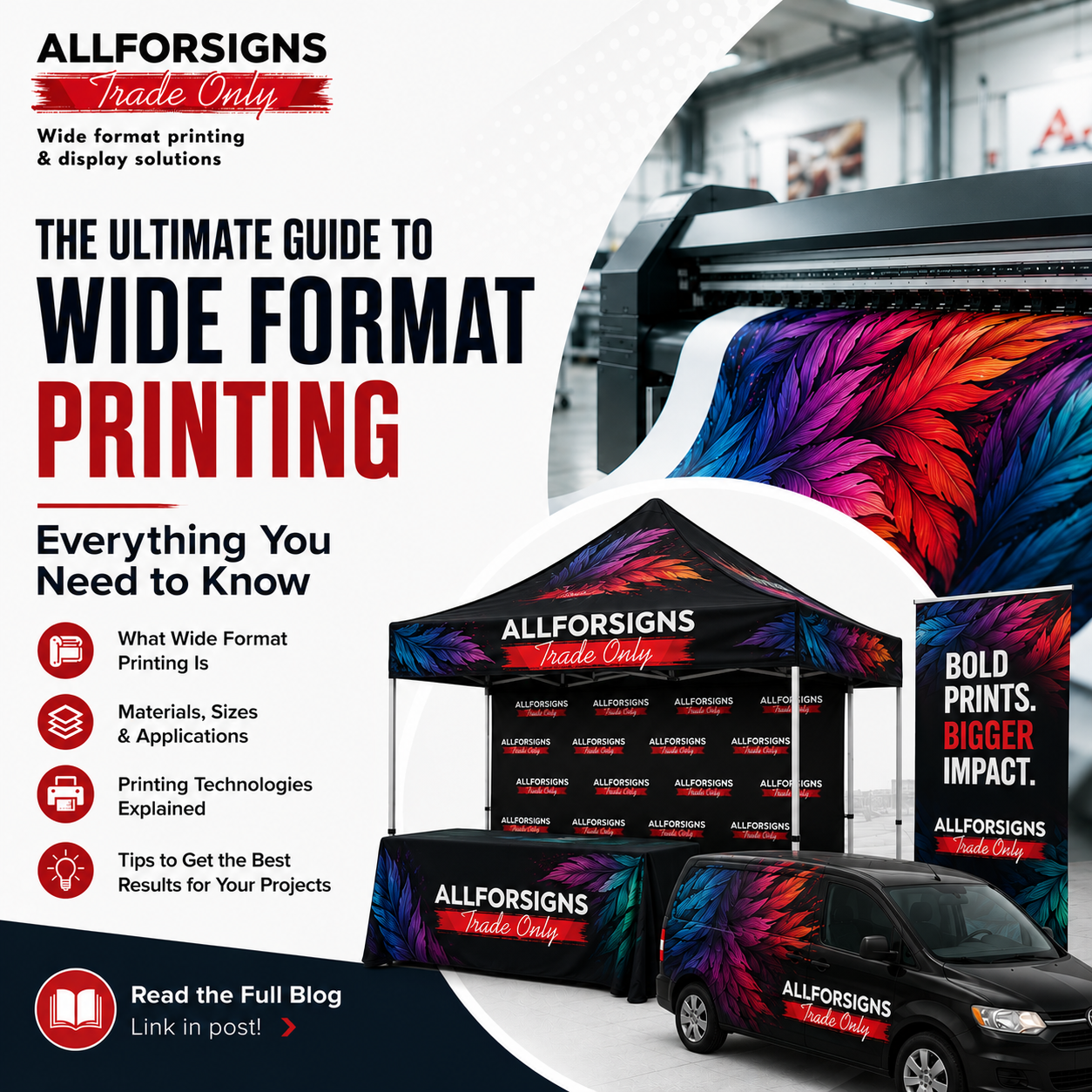
For step-and-repeat backdrops, wrinkle-resistant polyester fabric printed via dye-sublimation is the optimal choice, because it’s so photo-friendly. The matte finish prevents glare, skin tones look natural under mixed lighting, and color stays consistent across panels—exactly what clients expect from a professional step and repeat printing service.
Choose a stable hardware system to keep the fabric flat: telescopic frames for quick setups, or aluminum SEG frames when you need that perfectly taut, seamless face. Build the file with a sensible logo cadence (not too tight, not too sparse), confirm bleed to the actual sewn size, and keep critical artwork a touch inward—fabric stretches.
Outdoor events will benefit from tough canopies made from coated polyester and printed with dye-sub (for saturated color) or UV-curable inks (for speed and weather resistance). Custom canopy tents with logos are a great multitasker: both a shelter and a high-visibility billboard.
Look for fire-retardant materials, reinforced corners, and wind-rated frames. If you need floor graphics by the entry path, specify slip-resistant laminate rated for wet conditions. This is often what a wide format printer is used for—bundling all elements of the display, from the canopy skin to the site signage, into one coordinated operation.
If you’re helping your client set up a table at a trade show, a wide format printer will print table covers for your brand and help the team turn the booth into a prime brand display. The most optimal material, in this case, will not be paper (even specialty paper) but stretch polyester (form-fit) or throw-style covers (boxy drape) with dye-sublimated graphics for clean, crease-resistant visuals you can reuse all season. Cover style should match the table spec (4/6/8 ft; open-back for seated staff or full-back for storage).
Retail and corporate spaces usually prefer soft signage over shiny plastic. Silicone-edge graphics in aluminum frames (front-lit or backlit) give a premium, non-reflective look with fast swaps. For seasonal campaigns, recommend high-density polyester printed via dye-sub; for lightboxes, choose a dedicated backlit fabric to avoid hot spots. If your client needs a simple vertical banner with a refined finish, suggest tension-fabric stands or premium cloth—both are ideal as fabric banners for the business that photograph well and stay readable from a distance.
On that note: you should help your client plan for longevity and maintenance. Advise to use dye-sub fabric that can often be spot-cleaned or gently washed, then steamed back to form. If graphics will sit in a window bay, note UV exposure and consider rotating pieces to reduce fade. Ask them from the get-go to check the venue ceiling heights and mounting restrictions to choose the correct frame depth and hardware.
What is a wide format printer used for? Are there materials it cannot work with?Pretty much all impressive large-scale signage you’ve ever encountered was done with the help of a good wide format printer. Industrial wide format printers are built to be sturdy, extremely powerful and can handle nonstop production across multiple substrates.
This enables wide format printing across various materials: paper, fabric, vinyl, and, sometimes, even more rigid base, like PVC.
That said, there are some limitations to these printers. They usually cannot handle very thick or rigid materials (think wood and metal); extreme texture or unevenness on the surface, and, in case of dye-sublimation printing—any heat-sensitive material that will melt, warp, or discolor, which is why dye-sublimation is typically limited to sturdy fabrics, like polyester.
For durable outdoor signage and vehicle wraps, pair the service with solvent/eco-solvent or UV inks on the right vinyl. Calendered vinyl is fine for flat, short- to mid-term installs; cast vinyl with a conformable laminate is the standard for complex curves and long-term wraps. When color accuracy, lamination, and ship timing all matter, it helps to lean on a trade partner with real depth—such as a proven wholesale printing service in Florida—to keep production, finishing, and logistics under one roof.
Think through wind load and install points before you spec. Street banners need blockout vinyl and properly spaced webbing; construction fences call for mesh to relieve pressure; aluminum composite panels (ACM) deliver multi-year exterior duty with a clean, rigid face. If your search starts with wide format printing near me or Large format printing near me, remember that capability and blind-ship logistics often beat proximity when deadlines get tight.
So, Do I Need a Wide Format Printer?For resellers like you, the answer is a clear and confident "no." Trying to manage your own production, especially in wide format, is a massive drain on time, money, and focus. What you need is to divide and conquer—handle the client side of things and partner with a dedicated, trade-only wholesale producer to run things offstage. This approach will let you offload the headaches of equipment and maintenance so you can focus on what you do best: building relationships and selling.
And All for Signs has a few things to offer if you decide to partner with us, including iron-clad logistics, reliable nationwide shipping, and—most importantly—blind shipping services. We operate on a strict trade-only policy, which is your guarantee that we’ll never sell to your clients directly. By leveraging our expertise, technology, and unwavering commitment to the trade, you can confidently turn every client request into a success story. To learn even more about how All for Signs works, check our blog.


