
Call us:
754 263 3042

Thank You
Your account is pending approval. You’ll receive a confirmation email once activated.
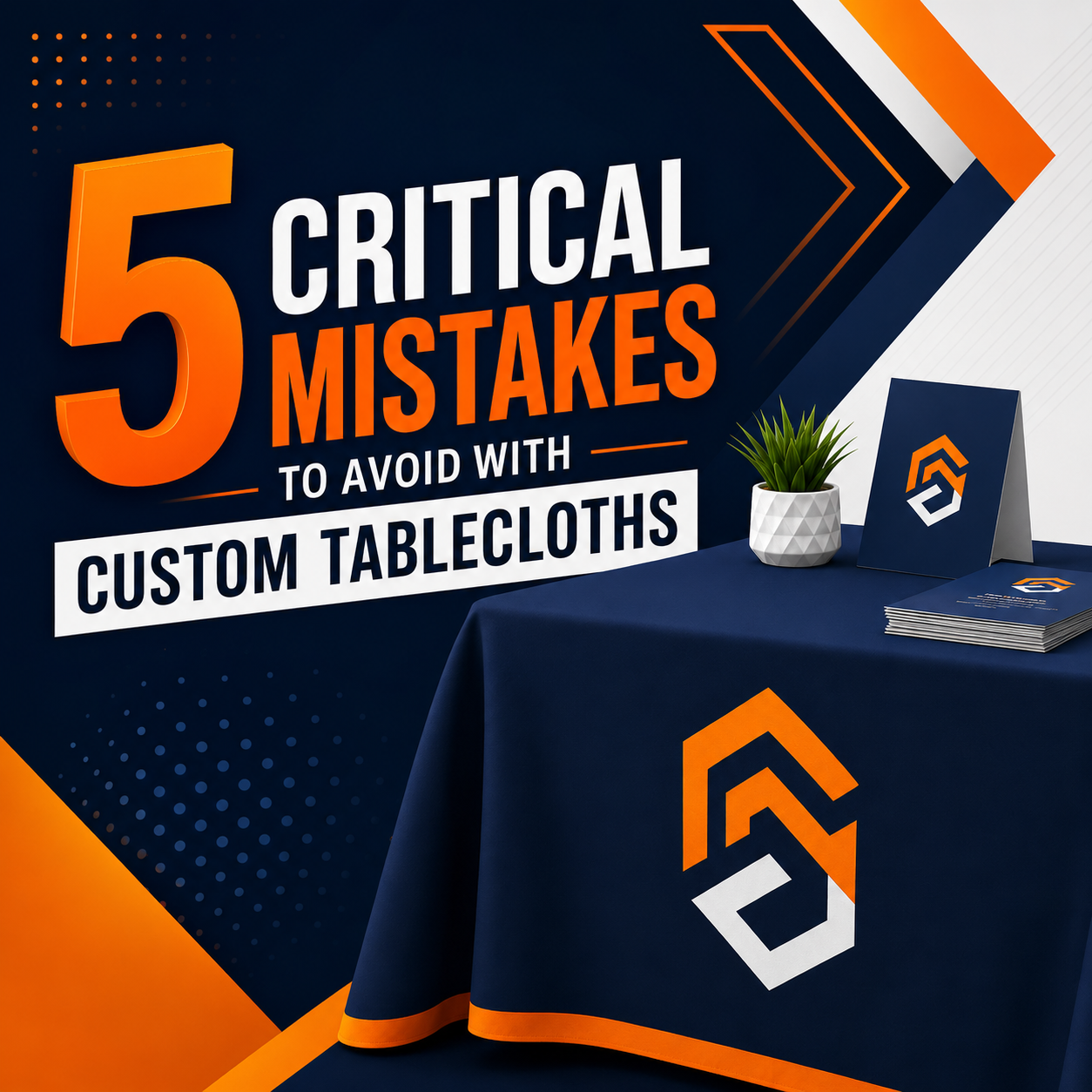
A polyester throw that looks perfect under controlled lighting can wilt outIn event marketing, you don’t get many do-overs—fail in the eyes of the client once, and they won’t be coming back. A small misstep with a custom table cloth can undo weeks of planning, especially when that cloth is the centerpiece of a booth. On paper, making a custom table cloth with a logo should be pretty simple. In practice, fabric, finishing, artwork, and environment all require a careful approach—make a mistake and it’ll be screaming no worse than a premium neon sign the moment you set up.
In this blog, we’ll break down the five most costly mistakes we’ve encountered most often while offering trade professionals our wholesale printing services. Accounting for each of them before putting in your order will ensure your clients’ custom table cloths look sharp, photograph well, and hold their own against premium competition at any trade show.
Mistake #1: Sending the Wrong File Type and Getting Blurry ResultsA client forwards a web header and expects it to stretch across an eight-foot table. They’re allowed, they’re not the professional printers—you are. And as a professional, you must know that on fabric, raster JPG turns into fuzzy edges and visible pixels—especially brutal on curves, thin serifs, and gradient strokes. Fabric has texture; with dye-sublimation, ink bonds inside the fibers. If the source art is low-res, the “stair-step” look is guaranteed on a custom table cloth with a business logo.
Fixing that mess is your job, but luckily, it’s an easy mess to fix: vector artwork (AI, EPS, or vector PDF). Vectors scale cleanly from postcard to backdrop, keep strokes consistent, and maintain brand color relationships. Photos can stay raster, but logos and type should be vector. Build this into your onboarding checklist, and you’ll save yourself (and your client) revisions and reprints while protecting the look of their customized table cloth with logo.
Sometimes your client may need help translating brand files into production-ready art—bleed, safe zones, Pantone bridges, and stitch allowances included. You might need to step up here and offer a light prepress package and show a proof of cloth plus booth accessories. It’s an easy upsell that improves outcomes and supports table cover printing for business.
Mistake #2: Not Accounting for Environment and Treating Every Venue Like a Trade Halldoors. Moisture, wind, and UV can turn a perfectly nice-looking banner into a shriveled mess. Indoors, a stretch fabric drape reads smooth and non-glare; outdoors, untreated fabric can absorb rain, flap in gusts, and fade under the sun.
The fastest way to prevent problems is to ask a single early question: where will the client set up the signage—inside or outside? Warn them that if it’s outside, the spec changes—heavier fabric weights, UV-stable inks, tie-downs, and thoughtful edges. Also, if they’re setting up an outdoor booth, suggest they pair it with other items; it’s an excellent opportunity to recommend some branded flags or canopy tent printing with logo.
And don’t forget the small things that make booths feel professional (and, by extension, the brands more upscale): grommeted cable-management flaps, sandbags wrapped in branded sleeves, and banner mesh for fence lines to relieve wind load. Those details keep a custom table cloth with logo looking composed instead of chaotic if the weather turns.
Mistake #3: Designing Pieces in Isolation Instead of Treating Visuals Like an EcosystemGreat table art will not be nearly as effective at representing the brand coherently if it clashes with the adjacent backdrop. A centered logo at table height might crowd the camera frame if the vertical piece repeats the same emblem at the same scale. The whole “brand cube” should work together: backdrop, table cover with custom logo, side banners, and any small countertop signs should create an ecosystem, not look like haphazard details thrown together at the last possible moment.
Use the vertical real estate for message and rhythm (repeating marks, tagline, or product imagery), and let the table carry a single strong mark. Keep skin tones and blacks honest under mixed lighting, and mind the horizon line where the table edge meets the backdrop; that’s often where visual noise shows up. This is also a natural place to suggest a photo-friendly backdrop through step and repeat printing for businesses—a classic way to make shots look clean on press and social.
If a client insists on intricate graphics across the cloth, steer them to a customized table cloth with a calmer front panel and let the pattern wrap the sides. It reads intentional and avoids “visual shouting” in photos. That way, the custom table cloths with logos remain the focal point, anchoring the space without fighting the backdrop.
Mistake #4: Not Ensuring Other Signs Are Up for the JobThe ecosystem rule stands not just for designs, but material, as well. Nothing undermines a premium cloth faster than a taped-up note that says “Register Here.” The material and finish of other signs should speak the same language that the custom business table cloth does. Use inexpensive substrates for parking arrows and wayfinding outside the booth—but upgrade anything that lives on or next to the main table.
For temporary, directional, or perimeter signage, lightweight rigid plastic is your friend. Yard signs, parking pointers, and fence notices are perfect use-cases for coroplast corrugated signs printing because they’re weather-tolerant, punchy, and affordable. They do the job away from the booth without stealing attention or budget.
At the table, raise the quality bar. Menus, QR codes, and “Talk to Us” prompts should sit on smooth, rigid surfaces that photograph well. PVC boards with their dense core and satin finish, for example, offer excellent print fidelity and durability on a relatively small budget, making them a go-to choice for countertop placards and hanging panels.
Mistake #5: Guessing at Size, Style, and Finishing, Instead of Measuring TwiceYou likely won’t be surprised if we tell you that the most common tablecloth problems are sizing problems. Six- and eight-foot tables are standard, but widths and heights vary by venue and vendor. A cloth cut for an eight-foot banquet can drag on the floor or ride too high on a narrower utility table. Confirm dimensions (length, width, height), then choose the style: throw (draped), fitted (box), or stretch (contour). Each style affects art placement and readability for a custom table cloth with a logo.
You, too, must have asked around, “where can I get a custom table cloth with logo near me?” when your first clients came knocking with their orders. The best answer is: “find a trade partner with in-house production and clear guidelines who builds to spec and ships on time.” Fit ties directly to pattern files and sewing tolerances; if those aren’t consistent, logos drift. A reliable, trade-focused shop will own sewing, color management, and finishing under one roof—precisely what All for Signs’s wholesale printing in Florida offers its partners.
Finish is the last mile. Open-back throws are great when staff sit behind the table and need storage access; full-backs look tidier from all angles for kiosks in the round. Stitch type matters, too: clean serging resists fray on travel-heavy kits; concealed hems keep edges crisp on camera. If you’re pairing the cloth with small rigid inserts—a mini schedule, offer card, or “Scan Me” prompt—choose a substrate that holds ink density and survives travel; that’s where tidy tabletop pieces produced as polystyrene signs can round out the set without adding weight.
When you guide a client from a single custom table cloth with logo to a small, well-built ecosystem—coordinated backdrop, clean countertop placards, and outdoor-ready accessories—you stop selling line items and start becoming an actual branding partner, key to their success. Don’t be hesitant to introduce durable add-ons, from SEG frames and banner mesh to portable signs that complement the main stage rather than fight it—even if the budgets are tight, and they can’t go further, you have already cemented your role: it’s you who elevates their simple scene to premium shine by standardizing sizes, protecting color with fabric-specific ICC profiles, and ensuring every customized table cloth lands correctly on the first try.
When offering all these choices, keep the brand vocabulary consistent: same logo lockup, color values mapped to fabric, and message hierarchy that makes sense when a passerby takes a quick glance. That coherence is why clients come back for a custom table cloth with a logo and, later, ask you to refresh the rest of their kit. Check the All for Signs blog, for more practical information.
After all, we’re in this as your partner: we’re a color-and-detail-obsessed, transparent about materials, and, most importantly, trade-only wholesaler. We’re after building a relationship with you, and your clients will never even know we’re here at all.


